Wednesday, September 24, 2008

A Message From the Detroit Lions


The Detroit Lions this week face a historic crisis in our football operations system. We must game plan to address our 0-3 record. If we do not, wins will dry up, with devastating consequences for our organization and fans. Our fans will no longer be able to cheer once every other game and their emotion investment will be at stake. Our franchise will not have enough wins to make the playoffs. If we do not act, every corner of our organization will be impacted. We cannot allow this to happen.

Last Sunday, we laid an egg in San Francisco and we have since discussed priorities and concerns with the game plan our coaching staff has put forward. This morning, we met with a group of front office staff to talk about the proposals on the table and the steps that we should take going forward. I have also spoken with members of the league office to hear their perspective.

It has become clear that we have no idea what we are doing. The only consensus that can be reached is there is no support for the current game plan. We do not believe that the plan on the table will pass – or run or defend – as it currently stands, and we are running out of time.

Tomorrow morning, we will suspend all football operations going forward. I have spoken with Commissioner Goodell and informed him of our decision and have asked him to have the rest of the league join me.

I am calling on the Commissioner to convene a meeting with the leadership from both conferences of the League, including All Davis. It is time for all teams to come together to solve this problem because we clearly can’t do it ourselves.

We must meet as football franchises, not as Lions or Bears, and we must meet until this crisis is resolved. We are directing our front office to work with the league to delay next Sunday’s game until we have taken action to address this crisis. We are willing to delay all 13 remaining games if we can. Despite these dire circumstances, we will be able to see the light at the end of the tunnel as soon as we move the limp bodies of our wide receiver busts are moved to the side.

I am confident that before the games start next Sunday - or by the start of the 2014 season - we can achieve consensus on a game plan for the Lions going forward that will stabilize our gridiron fortunes, protect season ticket holders and earn the confidence of the Lion fans. All we must do to achieve this is temporarily set competitive games aside, and we are committed to doing so. Just please remember, we believe the fundamentals of our franchise is strong.

Following that fateful 2001 season in which we went 9-11 after our front office didn't take the "NFL Determined to Play 20 Games Inside America" memo seriously, our organization came together to throw its support behind an ineffective leader. Teams across the country now lament that he is no longer indirectly helping them secure their own division titles because we are such doormats and directly preventing us from addressing our franchise's troubles. Now that there has been a change at the top, we hope we will eventually have the chance to prove that Detroit is once again capable of winning this league.

Source material.

Tuesday, September 16, 2008

Family Feud Glory


I love the Family Feud. I know it is childish and juvenile at certain points, but it is unendingly hilarious, mainly because of the blatant stupidity displayed on the show. When asked for a state where you can wear the same clothes year round, would you answer Washington, D.C.? Who thinks “whoops” rhymes with “barn”? Are clothes something just little kids wear? Does a bad golfer really go through a lot of carts? And is Regis Kelly one of Oprah’s best friends? Some of my favorite Feud moments can be seen here, here, here, and here. There is much more to love…watching people get an X to the face, listening to the audience respond en mass to the remaining answers being revealed, and having people give the Family Feud-default answer of choice – “making love!” A few weeks ago, when one of the questions was “Name something that children close their eyes when doing”, Alyse’s immediate response was “MAKING LOVE!”.

One of the more subtle aspects of Family Feud is their tendency to play racial groups against each other. I swear one time during college the Whites played the Blacks. And this happens with some regularity and certainly not with any malice. Just an interesting point of pattern recognition. While watching a few weeks ago with my roommate, we saw a family with an Adolph – dressed as a U.S. Marine, which we suspect was done for the sole purpose of deflecting suspension – playing the Schweitermans. Thankfully the Schweitermans handedly defeated Adolph, but the underlying context was tough to not miss and at least get a chuckle out of. (It was like when I went to a Catholic wedding this summer and the priest was joking about the flexibility of four year-olds…if you are going to lead me to the threshold of uncomfortable jokes, I will gladly cross it.)

This got my roommate and I thinking, what if the Obamas played the McCains played each other on the Family Feud? How hilarious would that be? So we thought about various questions and the candidates’ and their families’ responses, which carried over the next day to Gchat. The following is a “Best of…”, many of which are not by me. Please enjoy. And feel free to add your own.

“Name the most expensive electronic in your home.”
McCain: “My phonograph.”

“Name something you would hear at your local church.”
Obama: “God damn America.”

“Other than Democracy, name a form of government currently in use that you admire.”
McCain: “The feudal system.”

“Name a characteristic of middle class Americans.”
Obama: “Bitter.”

“Name something that costs less than a quarter.”
McCain: “A box of cereal.”

“Name a member of the Holy Trinity.”
Obama: “Me.”

“Name an invention you’d hope to see in your lifetime.”
McCain: “Sliced bread.”

“Name something people pop on a regular basis.”
Cindy McCain: “Pills”

“Name something commonly held in a football stadium.”
Obama: “Acceptance speeches”

“Name a recent event that thrilled the nation.”
McCain: “The Cubs World Series victory.”

“Name a place you wouldn't find lipstick.”
Palin: “A pitbull.”
Obama: “Hillary.”

“Other than the presidency, name a life goal of yours.”
McCain: “Visiting all 24 states.”

“Name something people hope for.”
Obama launches into his stump speech

“Name something a married couple may have more than 2 of.”
McCain: “Houses.”

“Name one of the 7 deadly sins.”
McCain: “Inexperience!”

“Name an unpopular sports franchise.”
Obama: “Mavericks.”
McCain: “Browns.”

A few other things about this election. I can't figure out how Obama let the "change" message get hijacked. I still don't understand how the Democrats allowed for this election to be more of a referendum on Obama than on Bush/Republicans policies of the past eight years. And I still don't see how Republicans can balance their desire for a nuclear family and to have such a inflexible position on abortion. I promise more regular posts now.

Sunday, July 27, 2008

Is Batman's middle initial W?


The popularity of a superhero is directly proportional to how well they reflect the contemporary political-social dynamic. The late 1930s and early 1940s demanded an impenetrable fighting force – both in reality and through our pop culture. Superman dutifully responded to the call and the Man of Steel's popularity grew accordingly. But more recently, ambiguity has riddled the concepts of truth, justice and the American way. Superman's resonance now echoes hollow as culture explores the grayer areas of a previously black-and-white society – and standing firmly at the intersection of darkness and light is Batman. To say that Batman better reflects 21st century America than any other superhero is to suggest a hierarchy where none exists; and the themes within The Dark Knight make Batman relevant to his time – meaning our own. He does not transcend the abysmal society in which he's born from. He becomes part of it. While the spectacle of surreal threats in the Spider-man films entertains us, it is energizing - and dually unsettling - when a film in this genre takes us someplace unexpected, namely the world in which we live.

While not mentioned explicitly in the film, Joker is the prototypical terrorist – a chaos-inducing agent, who acts not because he doesn't know better but because he relishes in the resulting bedlam. He is decidedly Hobbesian, wishing for a return to the state of nature because, in that context, no one will be able to stand him down.

And Batman is a one-man Department of Homeland Security, complete with his own Patriot Act – a "Batriot Act", if you will. He is a creature that, to the public, looks and operates like evil, but who is in creed and deed a fully virtuous man. Despite straddling the line between hero and outlaw, Batman applies his power and influence judiciously. He does not kill – or run the Joker over with the Bat-Pod after being taunted to do otherwise; nor does he unnecessarily trample upon the civic liberties of Gotham's citizens beyond when an imminent threat has passed.

The connection between the film's subtext and the current political environment is not difficult to see. And on the surface, the film seems to subtly nod its head in agreement with the path set by the Bush administration. A July 25 op-ed in the Wall Street Journal details these parallels between Batman and Bush.

While that initially seems to be true, the issues are as nuanced and two-sided as Harvey Dent's coin. Batman swears his foes crossed the line, but Alfred counters, validly illustrating the slippery slope of escalation by saying, "You crossed the line first...And in their desperation they turned to a man they didn't fully understand." Such is the nature of telling adversaries to bring it on. Batman also created an enormously powerful wire-tapping system and then immediately relinquished control, for its power was too great for a single individual to possess. While Batman can be certain that he will re-establish civil boundaries when the emergency has receded, one thinks that such a promise from the current administration would ring hallow.

Another point where the parallel falls apart is the simple fact that there is a reason Batman needs to wear a mask and hide his identity - because he course of action is not one that can be taken by elected officials. There cannot be relative disregard by figures towards the public they are in theory serving by trampling on both civil liberties and mores. We expect our leaders to reflect Batman's morals and virtues, but not necessarily embrace his methods.

Regardless of political leanings or whether one thinks Dent serves as a warning about the folly of placing all their eggs in a basket held by a single white knight, what can be mutually agreed upon is that the film derives much of its success by serving as a mirror of the culture it is serving.

I swear, this is the last Dark Knight related post and after almost a month of seriousness, I will come up with something more light-hearted for next week.

Monday, July 21, 2008

Partons of the Artist of the Beautiful

While I would love to give a review of The Dark Knight, I feel like too much has already been said towards the film’s quality. I can hardly add to it. It was a rich morality tale with a firm footing in both the arenas of crime drama and adventure cinema, but one where the action never eclipsed its intelligence. The subtext of the film – one spun tightly of terrorists, a one-man Department of Homeland Security and the danger of putting all of one’s eggs in the basket of a (delusional?) white knight. When more of my friends have seen it, I may post a review/explanation of the themes as I see it and try to tease out more of the subtext. For example, any doubt that Bruce Wayne is the alter ego to Batman is erased in a single decision made halfway through the film. Let there be no more debate on that front.

What I do want to touch briefly upon though is one’s capacity for awe and excitement as we age. There is a scene halfway through Knocked Up when Seth Rogen’s character is at the park with Pete (the fantasy-baseball-draft-sneaker husband) and Pete’s daughter. Pete is bemoaning the doldrums of aging, how life grows mundane and lacks joy. He tells Rogen, “I wish I liked anything as much as I like bubbles,” a defeated man who has watched all the promise and joy evaporate from his life. Bills, suits and responsibility ravage any enjoyment he may have. He lives in the real world equivalent of post-Mufasa Pride Rock. Promise and hope, joy and genuine excitement are such rare things. And I refuse to turn into Pete. The months of anticipation for The Dark Knight served as a nice reminder to me of what fun truly enjoying something can be – that even though the days of superhero lunch boxes and Trapper Keepers have long since been, we can still be childishly awed and impishly impatient. I found it relieving that I could be so excited by something so utterly inconsequential. As I made thank you notes out of pages from a Dark Knight coloring book for each of my friends who joined me for the movie or as I thought through the logistics of taking a three foot wide Batman balloon on the El to dinner and then to Navy Pier, it occurred to me how few of these moments there still are.

While the growing freedom we earn as we grow is appreciated, it takes some of the special/mysterious quality away from the outside world. We can go get a Happy Meal any time we want. R-rated movies aren’t all that special. Neither are most bars. The internet is flooded with top-heavy shirtless clownettes. Our capacity for amazement has been shrunk to a narrow, fleeting band and our desire for “amazement” is not always driven by the best of impulses. But having a few things that unmistakably remind us of our youth can be powerful in a way that escapes nostalgia and captures our dormant imagination. It is that much more special when the occurrences are beyond our purchase. That is, we can’t pay for a new Batman film anytime we want. We can’t demand with our Benjamin’s a new U2 album or book by Klosterman. It is almost entirely out of our control. And perhaps that is what is most subtly childlike about the experience.

Regardless of the reason, I was simply thrilled that I could enjoy both the anticipation of the film and the actual 152 minutes of footage on a 6 story high screen like I was – at least temporarily – a six-year old and know that the ability to be awed does not totally disappear as we leave a once seemingly endless Neverland.

Sunday, July 13, 2008

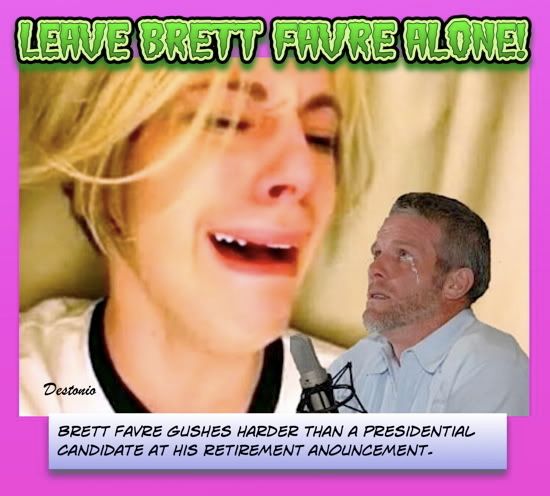
Favre Just Can't Quit You


To me, underlying motivations of fandom are inherently different sport-to-sport. Fans of baseball root for the game's traditional and urban/rural past as much as they do for the hometown team. Just look at the stadiums we build and revere. Basketball fans marvel at the individual accomplishments of the sport's stars as much as they revel of the achievement of individual teams. And in football, fans root for the logo on the helmet regardless of who hides themselves behind the anonymous mask and beneath the hulking pads. The sport is a byproduct of a society emphasizing structural functionalism, where the position being occupied is elevated about the individual occupying the position. It is a cold view of the surrounding world, but one that is entirely accurate for American football. Only the collective, synchronized action of the men in the Honolulu blue jerseys or star-emblazoned helmets matter, not who is executing them one year to the next.

And that is what makes this Brett Favre debacle all that more interesting. For the first time in recent league history, the identity of a single player has eclipsed the importance of the larger team - and thereby the logo on the helmet. Emmitt Smith nor Joe Montana, Jerry Rice nor Kurt Warner and Joey Harrington (OK, OK, I kid with the last one...) had the same identity larger than their individual team when they moved on to a finish their accomplished careers in an all-together foreign helmet. But one gets the feeling that a move by Brett Favre would ripple across both the league and Packer Nation in a way that none of the above moves could muster collectively.

(As an aside, I just want to posit my theory on Joey Harrington. He will continue to be an asshat until he starts to go by Joe. Joey just doesn't cut it in the NFL. You think Joey Montana would have won 4 Super Bowls? Or would Tommy Brady have 3 rings and a smoking hot girlfriend? What In-N-Out burger location might Stevie Young and Jimmy Kelly be working at? Mr. Unitas is the only one to get a pass because his last name is so absolutely perfect).

Favre could cause a total identity crisis for Pack fans. Would the anger and frustration over the front office's egos be enough to - at least temporarily - drive long-time Packer fans away from the team? And really, is there anyone under age of 23 that is actually a Packers fan or is everyone born after 1985 just Brett Favre fans? I honestly think this is the quintessential question that will be answered in the coming months. He is the only thing twenty-something Packer fans have known and I can empathize with that. If Steve Yzerman had pseudo-retired and then gone to play with a different team, I would seriously have to examine my fan-lationship with the Red Wings.

I have long thought that the most egotistical drama queen in sports was Roger Clemens. His act was tired and old. And now he is reaping what he has long sowed. But I would put Favre right behind Mr. Mindy McCready. The annual indulgence with his inner-Hamlet, the unending speculation about his future, the now melodramatic good-bye on Thursday night in the 2006 season finale at Lambeau and the New Year's Eve tears on the Soldier Field turf ten days later, then his emotional press conference in March and his continual dominance of the Lions all wore on me. I just wished (and despite the Phoenician rise last season, I still do) that he would just go away. But don't you dare tell that to a Packers fan. And their insistence and loyalty to Favre will be uniquely tested in the coming season. The Packers organization has long be held as an example of David consistently competing with Goliaths and connecting in a unique and lasting way with their fan-base - from the inherited ticket policy to the community ownership structure of the front office. These nuanced issues and flawed characters make the current situation ripe for the Shakespearian pen, but the lead role in the "Merchant of Menace" has yet to the cast. Does Favre truly mean more than the oblong G so long hailed and worshiped in America's dairyland? If you are a fan of the NFL, it is a fascinating question to ponder and to see how it is played out.

It's Bat-Week. A review of The Dark Knight will be posted next weekend. The forecast is 57 levels of awesomeness.

Monday, June 30, 2008

By Choice, Not By Chance


Superhero origins all pivot on circumstance. No self-destructing Krypton, no Superman on the Kent family farm. No radioactive arachnid, no Spider-Man. No misused gamma rays, no Hulk. And Batman's origin hinges on circumstance as well: no murder, no Batman. But Batman’s origin is not as simple as that.

What is noble about Batman/Bruce Wayne is that he chooses his path; he is a product of free will and determination, not chance. His parents may have been murdered, but he isn’t the only mourning son of slain parents. Unlike Superman, Spidey, or Hulk, the circumstance that grips Wayne’s world is shared by others. What differentiates the Dark Knight is that he embarks on his journey consciously. Spider-Man’s “great power” is thrust upon him by fate, forcing him to accept “great responsibility”. Wayne chooses the burden of great responsibility that sets him about a journey for establishing himself as a great power. Batman is a Horatio Alger-character – self-made and reliant, his effectiveness hinging upon cunning and ingenuity, not an inexhaustible supply of inherited power – while the others are more members of the Lucky Sperm Club. (This is particularly ironic because of massive wealth of the Wayne family.)

Very few other superheroes - and none of the big guns - choose their path. Clark Kent, Peter Parker, Bruce Banner, and Logan all have no choice in their alter-egos. They are victims of fate, subservient to the surrounding world. And my guess is that if Clark, Peter, Bruce and Logan were asked whether they would give up their superpowers to become regular humans, each would do it in a moment for a chance at normalcy. Wayne had normalcy and willingly embarked on a different path. His genesis was conscious, not manipulated by the heavy-hand of fate.

While Kent and crew painfully embrace their alter-egos, Bruce Wayne is the only one who truly becomes his alter-ego without reservations and emotional hindrance. And in doing so, Batman becomes the man's true ego, while Bruce Wayne becomes his alter ego. I am wont to believe that any character or person who chooses to become "something else entirely" - as Ducard says at the beginning of "Batman Begins" - assumes that "new" identity as their ego, relegating their previous life to their alter-ego. That is why I was so thrilled with how "Batman Begins" ended, with Rachael Dawes acknowledging that, "your real face is the one that criminals now fear. The man I loved - the man who vanished - he never came back at all. But maybe he's still out there, somewhere. Maybe someday, when Gotham no longer needs Batman, I'll see him again." That is EXACTLY right. He has become something else entirely and in doing so, marginalized another part of his life. By choice, not by chance. And this is what differentiates himself in the crowded superhero canon. Since Wayne chooses to assume the Batman identity, Bruce Wayne becomes the alter-ego, not vice versa.

(A quick aside and perhaps a point of clarification - based on this standard, James Gatz is the alter ego to Jay Gatsby because Fitzgerald's protagonist willingly chooses to be Gatsby rather than Gatz. Although this is slightly complicated by the fact that Gatsby is never bound by dual identities like Batman/Bruce Wayne is.)

And Batman is clearly a man on a mission, but it's not pursuit of personal vengeance. His aim is much higher than that. He wants Gotham to be a better place, a city where a young Bruce Wayne would not become a victim. In a way, he's out to make himself obsolete (this will be a central thematic tension in the new film). Spider-man, Superman, and Batman are all heroes who wish they didn’t exist. The difference is that Spider-Man and Superman wish that fate had not dealt them these super cards, while Batman wishes he lived in a world where he was not needed.

The cumulative effect of this is that the world Batman inhabits – the world without flying men and purple-pants wearing angry monsters, but with crime, grit and corruption – is that much more believable to us, the audience. We can understand how a man became a cape-and-cowl-clad creature of the (k)night and in some small way relate to him in a way that others can never be relatable to those watching their exploits. We can understand and empathize with Peter Parker, but not with Spider-man. We can feel for Clark Kent, but not for Superman. But we can emphasize with both Batman and Bruce Wayne. Now as for the Joker…

Wednesday, June 18, 2008

And That Is Why He Sleeps With A Swedish Model On A Nightly Basis


Quite simply, Tiger Woods is amazing. Woods is completing his application for "Best Golfer Ever" at a time when we can honestly say we remember the greatest at their greatest. And for people my own age, this is the first time we have witnessed something like this. Gretzky - whose prime came before my age of sports fandom - and Jordan - who we were never able to fully appreciate because we didn't know any better - skirt the boundaries of our memory, but Woods is planted firmly in the middle of our consciousness. Federer comes close and there are countless would-be heirs that are great (LeBron, Kobe, Crosby, Peyton, etc.), but not atop their sport's Mt. Olympus like Woods is. It is almost unconscionable than a single athlete has dominated an individual sport with as many competitors as he has. He has extended the frontier of individual accomplishment farther than any other single athlete probably in the history of sport. And it is a marvel to watch.

But it isn't fun. And it isn't fun because Tiger isn't all that much fun. Nor does he seem to be having any of it.

We can respect and awe at Tiger without enjoying him. His clutch putt on 18 was thrilling, but his reaction wasn't. His reactions are almost exclusively loud releases of tension and competitive rage. And there's nothing wrong with that. He is the most competitive and mentally strong athlete that I remember seeing. But there seems to be so little joy in his triumph. From the reactions to the victory-interview platitudes, there seems to be a quota on his fun. And that quota apparently is zero. I just want one Tiger moment where he tosses his club out of glee and surprise or reacts Justin Leonard style out of childish joy. (His fist pump is nice and all, but he is one of the worst high-fivers in sports history.)

He knows he is going to make the putts...there is almost no surprise like Mickelson's reaction on the 18th green of Augusta in 2004 quite simply because I find it difficult to believe he is surprised by anything any more. And never was that more apparent than this past weekend when we witnessed Tiger's intensity with Rocco Mediate's infectious charisma. While I want to see greatness in its prime, I'd prefer that Tiger trounced the field or had to grind out a win against some loud mouth bozo - I'm looking at you Sergio and Rory. It's tough to watch Tiger beat someone like Rocco - a golfer on the back nine of his career, never having won a major, and knowing a single victory at the U.S. Open would make his career. To root for Tiger in these situations is to board a bullet train for history where none of the brief stops are any more meaningful than any other until you get to History Stop #19. Rocco is traveling on the path next to Tiger's bullet train rails in a covered wagon, enjoying the ride and appreciating the moments as they happen.

Tiger is the frat guy making his way through all the girls from the hottest sorority on campus not because he enjoys it, but because he can and it is expected of him. And Rocco is the slightly awkward, but ebulliently charming boy in the corner who starts to flirt with a remarkably attractive female way out of his league. And things are going perfectly well, until Tiger swoops in, takes another trophy home, and leaves the good guy empty handed.